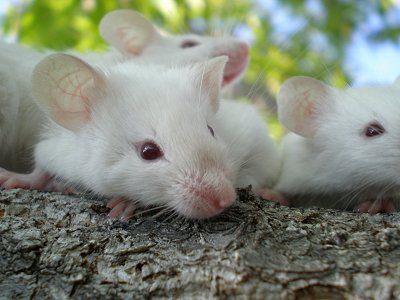
Regulation is needed to govern rapidly expanding research in animals containing human tissue or genes, according to the Academy of Medical Sciences.
It said such studies were necessary for medical research, but that new ethical issues could emerge.
It said "category three" experiments on monkey brains resulting in 'human-like' behaviour, should be banned.
The government said it would consider the recommendations.
Dr Robin Lovell-Badge, from the National Institute for Medical Research, said: "Everyone laughs at talking meerkats and cats with opposable thumbs, but if we were actually doing that in the labs I don't think people would be so happy."
Human-animals
Introducing human material into animals has furthered medical research.
Putting human breast tumour cells into mice has allowed researchers to test cancer drugs on human tissue.
Stroke damaged mice showed some recovery when their brains were injected with human neural stem cells, which has led to human clinical trials.
Down's syndrome mice have had a whole human chromosome added to their genome to help researchers learn more about the illness.
Professor Christopher Shaw, from King's College London and one of the report's authors, said animals with human material were "hugely important. Is [the field] going to shrink and go away? No. I'm confident it will lead to new treatments."
The Academy report said it was anticipating "a major increase in the use of these techniques".
However it raised concerns that some cases would fall through gaps in the regulation.
The authors said that, for example, experiments on an embryo which contained predominantly human material would be controlled by the Human Fertilisation and Embryology Authority and the embryo would not progress beyond 14 days. For embryos which are mostly animal, but contained some human material, they said there was "no regulation at all".
Animal research is regulated by the Home Office's Animal Procedures Committee.
Professor Martin Bobrow, chair of the Academy of Medical Sciences, said: "Our report recommends that the Home Office puts in place a national expert body, within the existing stringent system of animal research regulation, to provide specific advice on sensitive types of 'animals containing human material' research."
The Academy recommended three classifications for research on animals containing human material.
Most would be 'category one' and have no more restrictions than any other study on animals.
Category two experiments could be allowed but "would require strong scientific justification". The report suggested this would include adding genes to non-human primates and significant changes to an animal to make it "more human-like".
Category three experiments would not be allowed, such as letting any mixed embryo develop past 14 days, breed animals with human influenced sperm or egg cells and modifying non-human primates to create human-like awareness or behaviour.
Professor Bobrow was keen to stress that "nobody has done any of these things", but the Academy of Medical Sciences said it wanted guidelines in place rather than waiting until the horse had bolted.
Home Office Minister Lynne Featherstone said: "We welcome the valuable contribution of this study to the understanding of the complex ethical, scientific and animal welfare issues involved in this area of research. (James Gallagher/BBC News)
Showing posts with label health research. Show all posts
21.7.11
19.7.11
Mum's stress is passed to baby in the womb
A mother's stress can spread to her baby in the womb and may cause a lasting effect, German researchers propose.
They have seen that a receptor for stress hormones appears to undergo a biological change in the unborn child if the mother is highly stressed, for example, because of a violent partner.
And this change may leave the child less able to handle stress themselves.
It has already been linked to mental illness and behavioral problems.
The findings, published in the journal Translational Psychiatry, are based on a small study of 25 women and their children, now aged between 10 and 19.
And the researchers point out that the women involved in the study had exceptional home circumstances and that most pregnant women would not be exposed to such levels of stress day in and day out.
Furthermore, the researchers say the findings are not conclusive - many other factors, including the child's social environment while growing up, might be involved.
But they suspect it is the child's earliest environment, the womb, that is key.
For their study, they looked at the genes of the mums and the adolescents to find any unusual patterns.
Some of the teens had changes to one particular gene - the glucocorticoid receptor (GR) - that helps regulate the body's hormonal response to stress.
Such genetic alterations typically happen while the baby is still developing in the womb.
And the scientists believe they are triggered by the mum-to-be's poor state of emotional wellbeing at the time of the pregnancy.
Sensitive window
In the study, these mums had been living with the constant threat of violence from their husband or partner. And it would appear this continued stress took its toll on the pregnancy.
When the babies were followed up one to two decades later as adolescents, they had changes in the genetics of their GR that other teenagers did not.
This "methylation" of GR appears to make the individual more tuned in or sensitized to stress, meaning that they will react to it quicker both mentally and hormonally.
Stress hormones are regulated by the brain's hypothalamus Stress hormones are regulated by the brain's hypothalamus
As people, they tend to be more impulsive and may struggle with their emotions, explain the researchers, who carried out detailed interviews with the adolescents.
Professor Thomas Elbert, one of the lead researchers at the University of Konstanz, said: "It would appear that babies who get signals from their mum that they are being born into a dangerous world are faster responders. They have a lower threshold for stress and seem to be more sensitive to it."
The investigators now plan to carry out more detailed investigations following larger numbers of mothers and children to see if they can confirm their suspicions.
Dr Carmine Pariante, an expert in the psychology of stress at the Institute of Psychiatry, King's College London, said: "This paper confirms that the early foundation years start at minus nine months."
He added: "Pregnancy is uniquely sensitive to a challenging maternal psychosocial environment - much more than, for example, after the baby is born. As we and others have been advocating, addressing maternal stress and depression in pregnancy is a clinically and socially, important strategy." (Michelle Roberts/BBC News)
They have seen that a receptor for stress hormones appears to undergo a biological change in the unborn child if the mother is highly stressed, for example, because of a violent partner.
And this change may leave the child less able to handle stress themselves.
It has already been linked to mental illness and behavioral problems.
The findings, published in the journal Translational Psychiatry, are based on a small study of 25 women and their children, now aged between 10 and 19.
And the researchers point out that the women involved in the study had exceptional home circumstances and that most pregnant women would not be exposed to such levels of stress day in and day out.
Furthermore, the researchers say the findings are not conclusive - many other factors, including the child's social environment while growing up, might be involved.
But they suspect it is the child's earliest environment, the womb, that is key.
For their study, they looked at the genes of the mums and the adolescents to find any unusual patterns.
Some of the teens had changes to one particular gene - the glucocorticoid receptor (GR) - that helps regulate the body's hormonal response to stress.
Such genetic alterations typically happen while the baby is still developing in the womb.
And the scientists believe they are triggered by the mum-to-be's poor state of emotional wellbeing at the time of the pregnancy.
Sensitive window
In the study, these mums had been living with the constant threat of violence from their husband or partner. And it would appear this continued stress took its toll on the pregnancy.
When the babies were followed up one to two decades later as adolescents, they had changes in the genetics of their GR that other teenagers did not.
This "methylation" of GR appears to make the individual more tuned in or sensitized to stress, meaning that they will react to it quicker both mentally and hormonally.
Stress hormones are regulated by the brain's hypothalamus Stress hormones are regulated by the brain's hypothalamus
As people, they tend to be more impulsive and may struggle with their emotions, explain the researchers, who carried out detailed interviews with the adolescents.
Professor Thomas Elbert, one of the lead researchers at the University of Konstanz, said: "It would appear that babies who get signals from their mum that they are being born into a dangerous world are faster responders. They have a lower threshold for stress and seem to be more sensitive to it."
The investigators now plan to carry out more detailed investigations following larger numbers of mothers and children to see if they can confirm their suspicions.
Dr Carmine Pariante, an expert in the psychology of stress at the Institute of Psychiatry, King's College London, said: "This paper confirms that the early foundation years start at minus nine months."
He added: "Pregnancy is uniquely sensitive to a challenging maternal psychosocial environment - much more than, for example, after the baby is born. As we and others have been advocating, addressing maternal stress and depression in pregnancy is a clinically and socially, important strategy." (Michelle Roberts/BBC News)
12.7.11
Philippines - UP-DOST telemedicine project discovers rare skin disease in Mindanao tribe
“A dermatologist may not see this disease in his/her lifetime.” This is how Dr. Belen Dofitas, dermatologist of the University of the Philippines – Philippine General Hospital (UP-PGH), describes Tinea imbricata, a disease found infecting a tribe in Kiamba, Sarangani Province in Mindanao through the telemedicine project of the Philippine Council for Health Research and Development of the Department of Science and Technology (PCHRD-DOST) and the University of the Philippines National Telehealth Center (UP-NThC).
Tinea imbricata, also known as Tokelau ringworm, is an uncommon superficial fungal infection caused by Trichophyton concentricum. The disease is characterized by the formation of patches that are concentrically arranged, imbricated and known for its scaly rings and skin exfoliation.
“The disease is relatively rare. There are reports in scientific journals but only few around the world,” said Dr. Dofitas in an interview. In the history of dermatology in the Philippines, only three cases were reported - one in 1789 in Mindanao, another in 1962 in Mindoro and another in 1990, also in Mindanao. In all three cases, the disease occurred in ethnic and tribal groups.
“It was my first encounter with the disease and I have no idea about it,” said Dr. Lemuel Non, Municipal Health Officer and Doctor-to-the-Barrio (DTTB) of Kiamba, Sarangani Province, who found the disease on a walk-in patient in Kiamba Municipal Health Center. “What I did was, I photographed the infected part of the body of the patient, together with my initial assessment and forwarded it to the NThC via text messaging (SMS) and multimedia message (MMS) for evaluation and verification of the disease. It so happens that the municipality of Kiamba is one of the pilot sites of the UP-DOST telemedicine program.”
Telemedicine is an interactive audiovisual media that uses telecommunication and information technologies for the delivery of clinical care. It can be used for consultations, examinations and other remote medical procedures specifically designed to provide better health care services in the far-flung communities or the geographically isolated and disadvantaged areas (GIDA), where specialized medical experts are unavailable.
According to Mr. Sid Cardenas, technical staff from NThC, “when the assigned doctor does not know or is not sure what to do with the encountered disease/s in the field (particularly on specialist-specific diseases), this is where telemedicine helps.” The doctor forwards its initial assessment to the NThC servers through SMS, MMS or email. The report will be channeled to the telemedicine domain experts for diagnosis or management, and findings will be sent back to the doctor in remote site.
With the help of the UP-DOST telemedicine project, Dr. Non in Kiamba, Sarangani Province received relevant information from Dr. Dofitas in UP-PGH to properly handle the Tinea imbricata disease.
Beyond telemedicine
Since Tinea imbricata is a special case, the NThC technical staff together with the UP-PGH experts visited the municipality of Kiamba to conduct a follow-up health mission. “There may be other cases existing in the community. That is why we really need to go up there to find out the real situation of the tribe,” said Dr. Dofitas. “It is possible that some of their family members are also infected with the disease. Aside from that, we need to know how the community treats the disease and their perception about it.”
In cooperation with the local government of Kiamba, members of the tribe were invited for free medical consultations. “Because the tribe perceived that the disease is incurable, they were initially reluctant to be examined by the medical team. However, after learning that some of their members were successfully treated, the tribe was, eventually convinced,” said Dr. Dofitas. There were twenty eight individuals found infected with the rare disease.
“We also introduced “akapulko” for the treatment of the disease.” Akapulko is an indigenous herbal medicine abundant in the community that is found effective in curing skin diseases including Tinea imbricata.
Aside from medical consultations, the team also conducted information dissemination campaigns to increase the community’s awareness on the disease. “This is very important to change their mindset, to make them realize that the disease is curable,” said Dr. Dofitas.
Telemedicine project defies distance and lack of medical experts
According to the UP Manila - National Institutes of Health, 60 percent of Filipinos die without seeing a doctor. This may be due to the fact that being an archipelagic country, distribution of health care services could be a quite challenge.
“In an archipelagic country like the Philippines, telemedicine is an advantage to bring health care services in isolated and poor, underserved communities. It is a medical option that bridges “doctor-patient” geographical separation. Aside from that, it addresses the problem of lack of deployed experts in areas with high risks of diseases like Sarangani Province. That is why telemedicine is very important and should be incorporated in our health system,” said Dr. Dofitas.
She also emphasized that telemedicine has an important role in the continuing education of doctors, caregivers, and patients, and cuts the often high cost of travel and stay in nursing homes or hospitals through the efficient referral system among hospital experts anywhere in the country. (Edmon B. Agron/PCHRD-DOST)
Subscribe to:
Posts (Atom)

